60 Miles East is the story of Riverside from the perspective of two local kids who bonded over skateboarding and hardcore music in the early 1990s. They reconnected three decades later to document the scene that shaped them.
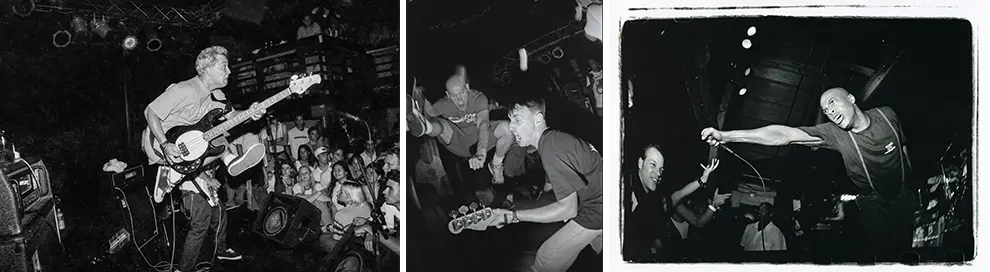
Ken Crawford and Zach Cordner first crossed paths in the hallways of Poly High School. They spent weekends at shows at backyard parties and in sweaty venues, collecting photocopied flyers, and discovering bands that would never make it onto MTV or commercial radio. Zach carried cameras to document what they witnessed, capturing the energy of live performances and the community that formed around the music. Ken served as chauffeur and provided a home base. His parents’ house became a place for listening to records and planning trips to shows.
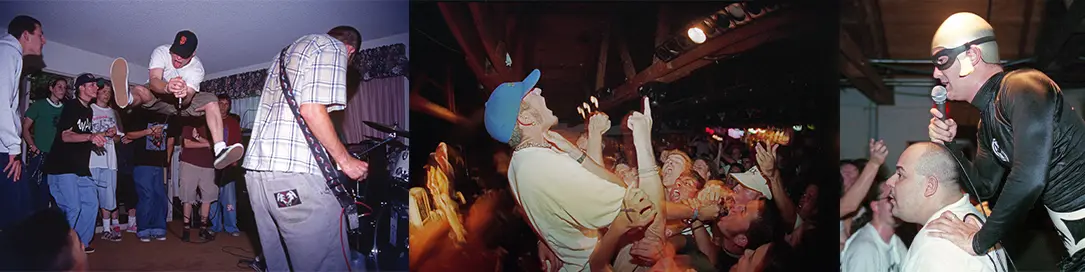
They were building an archive and the relationships that would prove important later. The photographs Zach captured during those years became the foundation for understanding how a community functioned before social media, before the internet made scenes instantly visible to the outside world. These images document authentic moments caught, not constructed. The immediacy of film photography reflected the immediacy of discovering music through friends, record stores, and hand-copied flyers.
Ken’s role proved equally crucial. The rides to shows, the gathering space, the network of relationships that made exploration possible. Every scene needs its connectors, the people who make things happen by bringing others together.
Three decades later, they reconnected as Editor and Publisher of Riversider Magazine. During conversations about covering Riverside’s cultural landscape, they kept returning to those formative years when the city’s underground music scene felt electric with possibility. They realized they had the contacts, the archives, and the perspective to document that era properly.
Riverside sat at the eastern edge of suburban sprawl in the 1990s. Any further east and you were in genuine wilderness: Joshua Tree, desert, mountains. Los Angeles and Orange County had their underground music scenes, close enough to feel the pull but far enough away that making the drive for every show wasn’t practical for teenagers with limited transportation and pocket money.
So Riverside did its own thing, wearing the outsider badge with pride. We’re not from LA. We don’t live by the beach. We’re from the smog and the heat, sixty miles east.
This distance created space for something distinct to emerge, free from the expectations of established scenes. Riverside’s underground developed its own venues, its own ethics, its own way of supporting bands and building community. The exhibition documents this specific cultural moment when geographic isolation fostered creative independence, and when a community of young people created lasting institutions that would influence music culture far beyond city limits.
THE SANCTUARIES
SPANKY’S & THE SHOWCASE THEATRE
The thriving all-ages music scene in 1990s Riverside is largely possible because of downtown restaurant owner Ezzat Soliman.
Spanky’s began with bands playing on the round stage outside City Hall, earning tips from passersby. When Ezzat approached them about moving inside his restaurant and splitting door money, what emerged became one of the most important venues in West Coast punk history.
Ezzat Soliman died in June 2025 as we prepared this exhibition. His passing reminds us that this story looks very different without his involvement. When you scour the dozens of tributes on social media, the comment sections overflow with a common theme: Ezzat created a place where all felt welcome, where outcasts found refuge, where people who may not have had success at school or nurturing family lives could find a place where they fit.
His family’s cooperation has been crucial to what we are doing here, helping us preserve not just the history but the spirit of what made these spaces special. His involvement in punk may not have been intentional, but that doesn’t diminish its importance.
But the sanctuary couldn’t last in its original location. When the Mission Inn was purchased and prepared for reopening, Riverside ’s redevelopment agency envisioned a downtown that would attract high-end tourists for elegant evenings. This vision couldn’t coexist with the reality of where young people were gathering at clubs like Attitudes (a dance club) and Spanky’s.
The displacement forced Spanky’s to relocate to Corona, where it became the Showcase Theatre. What might have seemed like a setback instead positioned the venue within the broader regional network that made the Inland Empire scene possible. Rather than just serving local Riverside bands, Showcase became a premier all-ages destination that drew touring acts from across the world from the mid-90s until the early 2000s.
Ken Stansbury describes how different scenes functioned as “gears that came together to make the overarching scene, like a watch.” Each area had its own character. “Each scene was helping to promote, and then Spanky’s hit… they were all gears, multibands within those scenes, and each scene was helping to promote.”
THE 98 POSSE STORY
Promoter Bill Fold and 98 Posse turned friendship into a sustainable career model. What started as friends throwing warehouse parties in the late 1980s evolved into one of the most influential promotion crews in punk rock history. Bill’s approach was revolutionary in its simplicity: treat bands fairly, keep shows all-ages, and maintain the relationships that made it all possible. The name itself comes from Public Enemy. In their early records, Public Enemy’s crew referenced driving “98s” (Oldsmobile 98’s) instead of the typical Cadillacs that other hip-hop crews favored. Bill was into both cars and Public Enemy at the time, adopting the name from lyrics like “my 98s tough to chase.”
“I was like, they can’t do anything with 98 if it’s not all ages,” Bill recalled. The all-ages policy was non-negotiable. The crew’s commitment to accessibility extended beyond door policy. “I just always tried to do right by everybody, tried to always, you know, overpay when possible, if we oversold, we tried to overpay.”
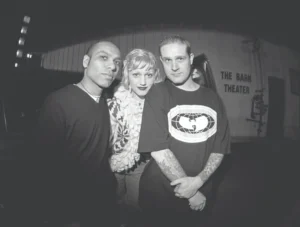
98 Posse’s Bill Fold with No Doubt, backstage at the Barn, 1998
The UCR Barn became their primary venue. The Barn is older than the campus itself and has been a place where students gather through many different iterations over the years. For most of the 1990s, 98 Posse booked the Barn several nights a week, and its presence had a huge impact on the Riverside scene. Ironically, many UCR students had no idea what was going on there because it wasn’t around any housing or places where students spent their evenings. The Barn is still there but almost unrecognizable from the 98 Posse days since its major renovations.
The 98 Posse crew were made up of a group of kids from Riverside and Moreno Valley that were into skateboarding, music and general troublemaking. Eventually Travis Barker started to hang around helping around the office and working shows. Travis would listen to all the band demo tapes, making piles of which acts should get shows and which shouldn’t. “That was his job… all the incoming bands, he would make a pile of ‘we should put these guys on shows, these guys are great.’” according to Fold.
When Travis left the Aquabats for Blink-182, the friendship endured despite some initial tension. Bill had advised Travis to take the Blink opportunity over the Suicide Machines, Travis’ favorite band at the time. The same ethics that governed those early Barn shows scaled up as the crew grew with Goldenvoice, eventually producing some of the biggest music festivals in the world including the Coachella Music & Arts Festival. This wasn’t just business development. It was friendship as a career path. Some of the 98 Posse members are still working Goldenvoice concerts over three decades later, having figured out how to turn hanging out with their friends into a job that lasted a lifetime.
The extensive flyer routes became legendary. Bill and Art Moreno would load up the “Persian Golf” —a blue VW Golf car bought from Ken Smith—and methodically hit every record store, skate shop, and youth hangout from Riverside to LA. “It was like military-precision operations that ensured maximum scene penetration,” as Bill described it. They operated differently from other promoters who used pay-to-play models where bands had to sell tickets to their friends or forfeit equipment. Bill understood, “Because I was inside of it. I was already there… I was at these shows with these guys, whether they were playing or not.”
Many of the relationships forged through 98 Posse endure decades later. The model they created challenged the typical music industry approach. Instead of viewing success as a ladder to climb away from origins, they built something that allowed them to grow while maintaining connections to the community and values that started it all. The endurance of those relationships demonstrates something distinct about the Riverside approach to scene building.
TREASURE MAPS
 Hand-drawn directions to shows, addresses scrawled on napkins. Misspelled street names, not to scale, but they got you there. Photocopied flyers with venue info that might or might not be right. Half the adventure was finding the place. Before cell phones, before the internet, before GPS, the punk scene operated on faith and hand-drawn maps. The romance of uncertainty drove the experience. Information traveled through photocopied flyers, directions written on whatever was handy, and word-of-mouth instructions that always seemed to include phrases like “turn at the big tree” or “it’s behind the auto parts store.” Directions would be scrawled on notebook paper, the back of other flyers, sometimes directly on your hand with a ballpoint pen. Street names were frequently misspelled. Maps weren’t to scale. But somehow, you’d find your way to the warehouse in Ontario, the community center in Corona or the backyard in Moreno Valley.
The effort required to find shows created investment in the experience. By the time you finally arrived, having decoded the directions and navigated the back roads, you were already part of something. This wasn’t just about logistics. It was about creating community through shared effort. When everyone had to work to find shows, everyone was invested in making sure they happened.
98 Posse perfected the art of information distribution with their legendary flyer routes. The “Persian Gulf” car would be loaded with boxes of flyers, and Bill and Art would spend entire days methodically hitting every record store and skate shop from Riverside to LA. “We had a flyer route car… and to be part of these shows, we all flyer, we all go do the flyer route.” The flyers themselves were works of art and information design, cramming band names, venue details, age policies, and ticket prices into spaces the size of index cards. They were proof you’d been there, evidence of a scene worth documenting. The best ones became collectible, trading hands long after the shows they advertised.
Bill Fold mentions how the flyer route was crucial to their success: “The flyer route was a major part of a face and personality, and the genuineness of who we were. We listened to the music, we liked the music, we knew the bands. We hung out with the bands and we were at the shows.”
These treasure maps represented something larger than navigation tools. They were proof that scenes existed, that communities were building, that something important was happening sixty miles east of the center of everything. The physical act of following hand-drawn directions connected people to a larger network of kids creating their own entertainment, their own cultural spaces, their own rules about what mattered.
THE SCRIBES (DON’T F*** YOUR PRINTER)
“The first thing I told Mike and Shale when they started Mean Street,” recalled Ken Stansbury. “Don’t f*** your printer. Ever. You miss press time because you’re not ready? Too bad. You roll with what you have. Your credibility depends on consistency.”
In the pre-internet world, this wasn’t just practical advice. It was survival doctrine. Fanzines printed at Kinko’s at 2am, stapled by hand, distributed at shows. Without these documents, some of us wouldn’t remember any of it. The writers who made sure the scene had a voice and photographers who hold the visual record of the era.
Ken Stansbury hosted poetry readings at Aroma Cafe (where Gram’s Mission Barbecue is now) from 1985-1988. “They were great. It was when you could smoke inside. They served beer. It was a great coffee house.” Some of the punk bands would do stripped-down, unplugged versions at these readings. “And that was finally cut short after about five or six months when a pit started.” 
Mean Street Magazine started a year after Spanky’s opened, when Mike Halloran and Shale approached Ken through an introduction by Mark Goldstein. Ken consulted for six months initially, then stayed longer when they expanded. The magazine shared office space with 98 Posse, with designer Mike Roccio serving as the visual bridge between the magazine and the promotion crew. Roccio taught Bill Fold computer design skills while helping establish Mean Street’s professional appearance that set it apart from typical zines. “Mean Street had what was called ‘other side of the street.’ It didn’t have classifieds, and in the very back it had poetry. So some of the punk poets were submitting their poetry for Mean Street,” Ken said. “And there were nights at Spanky’s where poets would get up and read between bands.”
Stansbury understood the broader cultural context: “There was a community ethic that still permeates even now… it was more genuine, right? And it was DIY, and there was a community ethic.”
Magazines like Mean Street, Skratch, and Factor X formed the nervous system of underground music scenes nationwide, connecting isolated pockets of punk, ska, and hardcore across geographic distances that felt impossible to teenagers without reliable transportation. Mean Street’s larger format and professional distribution set it apart from photocopied zines stapled at kitchen tables. While smaller publications documented shows and championed local bands, Mean Street provided legitimacy that venue owners, record labels, and touring bands recognized.
The magazine ran ads for Goldenvoice, 98 Posse, Showcase, and other promoters, creating a shared calendar that helped scattered fans feel part of something larger. Its consistent monthly schedule meant the Riverside scene had a reliable voice in the broader underground network. These publications weren’t just documentation, they were community infrastructure. They connected scenes, legitimized venues, and created the shared language that made regional networks possible. Without these printed documents, much of this history would exist only in fading memory and personal collections.
ANCESTOR WORSHIP
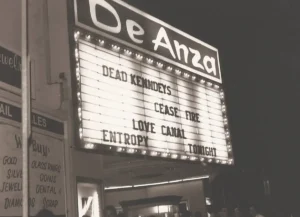 There were venues before. Big theaters, bars, nightclubs. The De Anza Theater, Monopoly’s, even the bandshell at Fairmount Park. Most had closed by the time we were old enough to care, and most were rental halls anyway, not the kind of places you build a scene around. Not places where people knew they could show up on a weekend night and see a band of some sort.
The ancestors didn’t wait for permission or proper stages. They didn’t know they were starting something, they just knew they had something to say. Raw energy before anyone told them how it was supposed to sound.
Ken Stansbury describes the early foundation: “Before the quantification of hardcore, reggae, jam bands, you know, you’d have Hari Krishnas… straight edge.” The diversity was key. “You would have these hardcore goths playing with a jam band…or a reggae band. It was a mishmash, and people absolutely soaked it up.”
House parties in orange groves where bands set up Marshall stacks in backyards. The Skeletones, early Voodoo Glow Skulls, and countless bands whose names live only in memory. Equipment failed, vocals were buried, everyone learned by doing. But there was authenticity and urgency that couldn’t be manufactured. Bill Fold started with warehouse break-in parties in the late 1980s. He found ways to get into empty buildings on Jurupa Ave, mark them with fake business names like “Bob’s Automotive,” and throw shows until the cops inevitably arrived. “We would literally leave with the crowd, complaining about, ‘this is a ripoff!’ This goes back to the days we were fucking with people.” These weren’t just pranks. They were proving that you could create scenes anywhere, that official sanction wasn’t required. “I threw a party at Warren and Hans’, they had a house that they got evicted from and they got like a three day notice,” Bill recalled. “So we threw a party on whatever the third day was. It was just like a full rager… And I was like, okay, this is easy.”
The ancestors established that DIY wasn’t just an aesthetic choice, it was the only option if you wanted something to happen in Riverside. These ancestors laid the groundwork, creating the DIY community template that would define Riverside’s approach to underground music. They proved you didn’t need established venues. You could make your own.
The house parties in orange groves weren’t just about music. They were about community building in spaces where mainstream society wasn’t watching. Ken described it, “There was good contained house partying, which you could have great house parties with bands back then, on pieces of land, ‘cause we could do them with Marshalls stacks out in Arlanza and La Sierra.”
THE HEROES
But a few bands ascended to hero status. They proved you could make it without leaving, without compromising. Local legends who showed the rest of us it was possible.
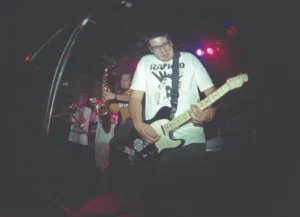
Voodoo Glow Skulls
Voodoo Glow Skulls became the ultimate example. From backyard parties to Epitaph Records, touring the world but never stopping being Riverside guys. They still lived here, supported local shows, treated their success as belonging to the community that supported them.
The Casillas brothers, Frank, Eddie, and Jorge, and their crew went from playing backyard parties to signing with Epitaph Records, touring internationally, and appearing in movies, but they never stopped being Riverside guys. They also owned Cheap Guy Muzak, a record store that served as a DIY music venue and a home for the scene out on the western edge of Riverside. Bill described his relationship with them, “Frank and Eddie did not trust anybody… Like, they didn’t trust me. I had a hard time with them for a while… It took years before we were cool… But I understood it. They would go around, they had like 30 people in their band, and you get fucked. It’s hard to get to the next spot if you’re not getting what you’re supposed to get.”
Heroes were bands that maintained their integrity, supported other local acts, and proved that they could build a sustainable music career from an Inland Empire base. They showed younger musicians that the choice wasn’t between staying local or selling out. There was a third path that honored both ambition and community.
Other bands achieved different versions of heroism. Some got regular airplay on KROQ. Others built devoted followings that sustained them through decades of touring. A few members went on to join nationally known acts like Travis Barker’s trajectory from local drummer to global celebrity. But the definition of “making it” in Riverside was broader than commercial success. The heroes were accessible. They would hang out after sets to talk with fans, understanding their success was inseparable from the scene that created them. As Bill noted, “When Hatebreed was coming through, it was like, ‘yo, I heard about the burrito.’ That was the show.” The Carlos O’Brien’s four-foot burritos became part of punk folklore, with bands specifically requesting them when booking shows at the Barn.
Local legends who proved it was possible while staying rooted in the community that made them. They understood that their success belonged to everyone who had supported them along the way, and they acted accordingly. This accessibility and community connection distinguished the Riverside heroes from typical rock star behavior, creating a model that influenced how success could look in underground music scenes.
THE CONVERSATION CONTINUES
We understand the limitations of our own experiences and don’t purport to have the complete story of this era. We want 60 Miles East to be a point of coalescence for all of us. The story of what made us different.
60 Miles East is an expanding brand and umbrella for Riverside storytelling. If there’s something you feel we missed, somebody or someplace that is uniquely Riverside that we overlooked, we want to hear it and tell those stories as well. This exhibition is hopefully the first of many under from Sixty Miles East umbrella. Creating space for Riverside to define itself rather than be defined by others. The Riverside Art Museum gallery exhibition is the first of many projects from 60 Miles East. We want it to be the story of our experiences about what makes us different.
The exhibition 60 Miles East: Riverside’s Underground Punk Rock, Hardcore & Ska scene from the Late 1980s to Early 2000s at Riverside Art Museum, will be open to the public from November 1st until April 12th, 2026.
This content is courtesy of Riversider Magazine, originally published in the October–November 2025 issue. Read the full issue here.