Part 1: Back from the Dead
The Farm House Collective is more than just another entertainment venue: it represents a family’s deep love affair with Riverside and their determination to breathe new life into a neighborhood they’ve watched decline for decades. Beverly Bailey’s connection to the University Avenue corridor runs soul-deep, rooted in memories of first dates and family history that spans generations.
“My family was in the military stationed at March Air Force Base, and our family moved here in ’76,” Beverly recalls. “I saw a lot of Riverside’s growth, and what stuck out to me was there was a lot going on in the area where the farmhouse is.” The area held personal significance—she worked at Chan’s restaurant, her family owned the Hacienda motel next door, and she had her first date with her husband at Cask ‘n Cleaver. All three buildings eventually burned down, leaving painful reminders of what was lost.
“Just watching all that go away and being able to hold on and sustain and bring life back through the farmhouse is really sweet and gratifying,” Beverly explains.
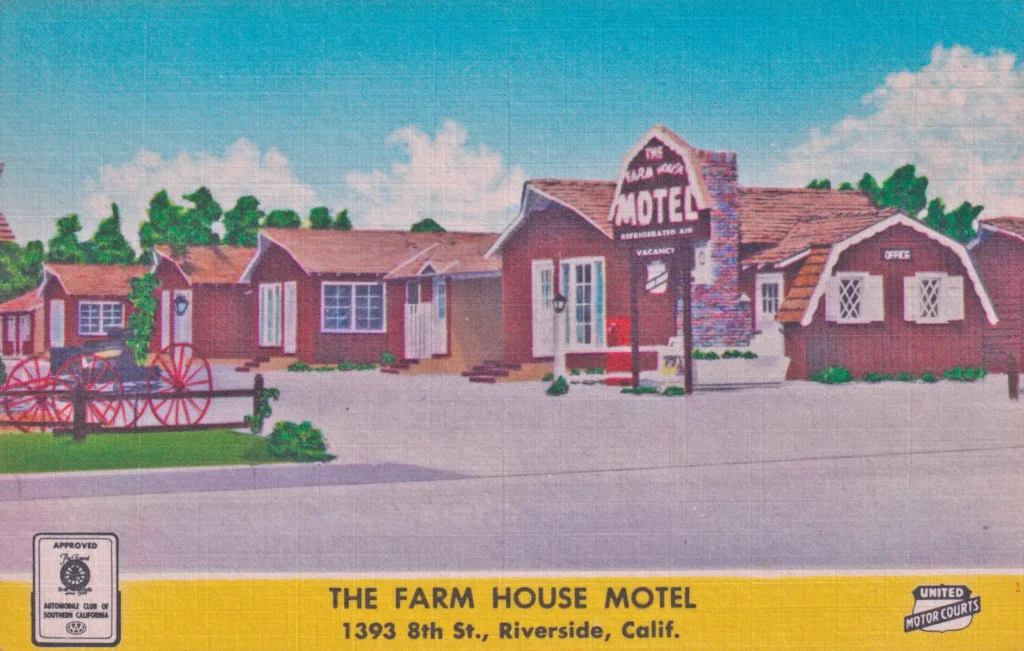
The Farmhouse Hotel // Postcard from 1950s
The programmatic architecture of the original farmhouse building, one of the last remaining character structures on University Avenue, made preservation even more compelling. Rather than demolish and start fresh, the Baileys committed to a full restoration that would honor the building’s history while creating something new for the community.
For Beverly, the project represents more than business success. The Bailey family’s successful construction business provided the resources to tackle what others might have seen as an impossible restoration project. The Baileys have built from the ground up, taking Stronghold Engineering from a home-based electrical business to a successful full-service construction company. But this wasn’t philanthropy in the traditional sense; it was more personal.
“We’ve been blessed and fortunate to have a successful business in construction, and being able to utilize some of those blessings into a project like this is a family legacy,” she says. “I just hope that my kids are embracing Riverside, that other families will feel the same way, and Riverside will be more than just something that you pass through, but people will realize and see how unique and wonderful our city is.”
The farmhouse sits strategically positioned to connect UCR students with the broader Riverside community, creating a safe, walkable destination that bridges campus life with city culture. It’s a vision years in the making, born from genuine love for a city and neighborhood that deserved better than decline.
Part 2: The Collective
The vendor spaces at Farm House Collective reflect the same commitment to quality and permanence that drove the building’s restoration. This isn’t a typical food court or strip mall collection of businesses: it’s what Beverly Bailey calls “a beautiful collective of independent creatives,” carefully curated to create a cohesive community experience.
The emphasis throughout the project has been on craft and quality over quick profits. Unlike many entertainment venues that start small and hope to grow, the Baileys front-loaded their investment to create something built to last from day one. The contrast became evident during the ribbon-cutting ceremony—a well-attended but comfortable afternoon event that transformed into a parking nightmare by evening when the concert began, with cars filling what seemed like a square mile around the venue.
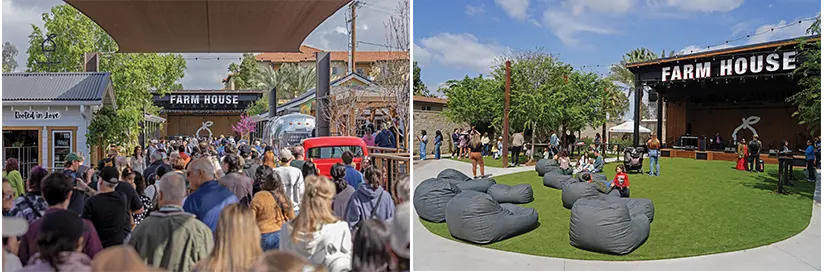
“If you build it, they will come” proved prophetic, but the success stems from the attention to professional details often overlooked in startup venues. This is a high-quality, clean, professional concept with excellent facilities—family-friendly and all-ages, representing something genuinely new for Riverside’s entertainment landscape.
The vendors themselves benefit from this professional infrastructure. Rather than the typical struggling startup scenario where businesses hope to eventually afford better locations, the Farmhouse tenants begin with proper plumbing, permits, and the kind of foundational stability that allows them to focus on their craft rather than survival.
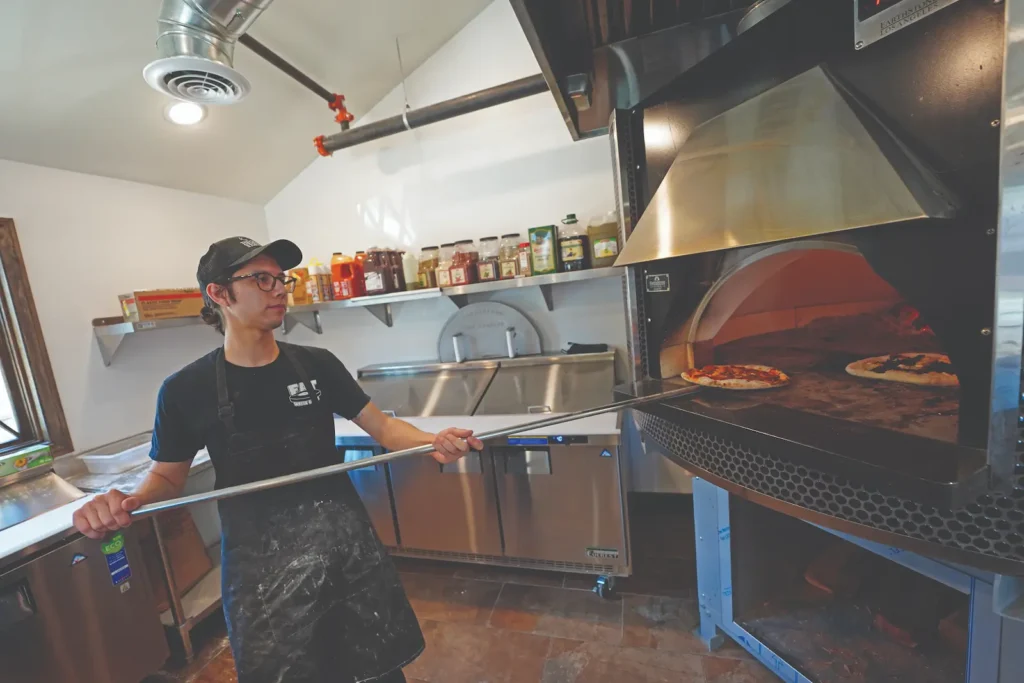
Vendor Bricks and Birch
Currently open vendors include Bricks & Birch wood-fired pizza, Benedetto Gelato, Go Go Bird, Ga-Tang, Blue Bowl acai bowls, Batter Rebellion‘s gourmet burgers, Bar Ni Modo craft cocktails, Cold One beer garden, Rat City vinyl records, Eco Now sustainable products, Pocket Change vintage finds, and Rooted in Love plant shop.
The Farm House Collective has only been open a couple of months, but it has already become a place where families meet and gather. The transformation is remarkable: what was once a spot of actual danger has emerged as a destination where parents comfortably bring their kids to play. The vibe change is palpable. These retail and food offerings complement rather than compete with each other, creating an environment where families can spend entire evenings. Parents can browse local artisan goods while children enjoy age-appropriate entertainment, then everyone can gather for dinner before a show. It’s a model that recognizes how people want to spend their leisure time: not rushing between disconnected venues, but settling into a space designed for lingering.
The Baileys’ investment in acquiring the adjacent Hacienda motel property for parking and additional vendor space demonstrates their long-term commitment to the concept. They’re not testing the waters; they’re creating an entertainment destination with room to grow and evolve with the community’s needs.
For local entrepreneurs, Farm House Collective offers something rare: a professionally managed space where their businesses can thrive without the typical infrastructure headaches that derail so many promising ventures.
Part 3: An Itch That Needed Scratching
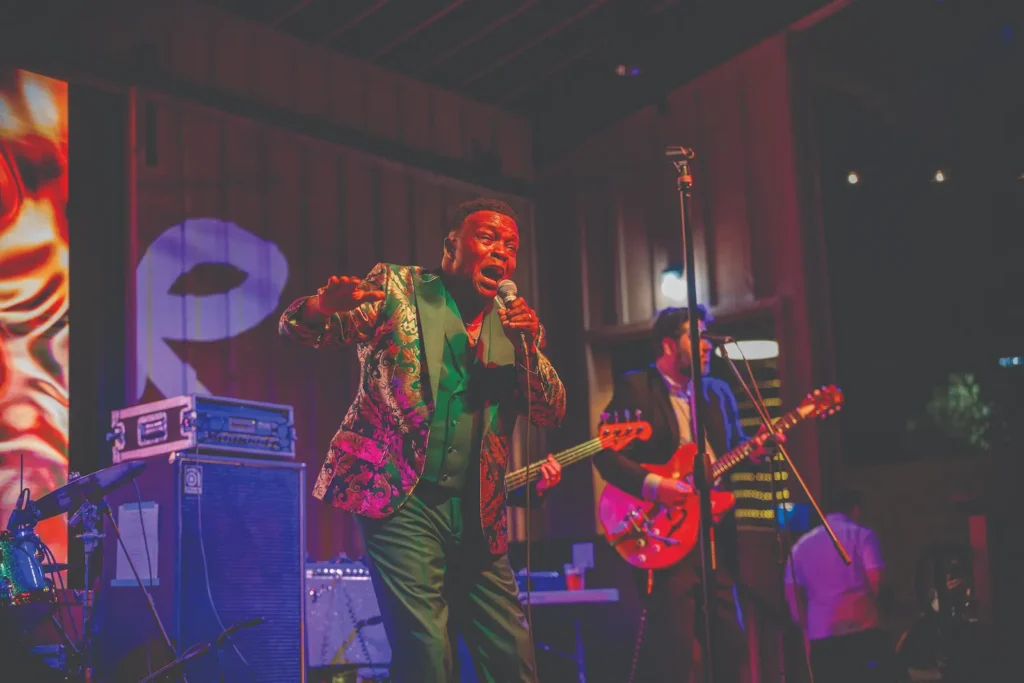
Daptone Records artist Lee Fields performs at the Farm House Collective
When music industry veteran Phil Pirrone talks about Riverside’s entertainment landscape, he speaks with the authority of someone who’s spent over two decades building relationships and understanding markets. His partnership with Farm House Collective represents more than just booking shows: it’s a strategic effort to put Riverside back on the map for touring artists who have long skipped the Inland Empire.
Pirrone’s credentials speak for themselves. Since founding the Desert Days festival in 2012, he’s booked legendary acts like Iggy Pop, My Bloody Valentine, Stereolab, and Tame Impala. “Getting Iggy Pop was a pretty surreal moment for me,” he recalls. “I was really sick, and I was in the UK on tour, and I was in bed, and I got the word, and I just yelped in my bed with my little sick, cracked voice. Never been so happy in all my life, outside of the birth of my two children.”
The connection to Farm House Collective developed organically. Kyler Bailey, who attended his first Coachella in 2003 as an eighth-grader and became a regular Desert Days attendee, reached out while the venue was still under construction. “I grew up loving music, going to concerts, and we’d have to travel outside Riverside to go to shows,” Kyler explains. “I’ve been familiar with Desert Days and I was always thinking that they were hosting the festival. I thought it’d be a great collaboration.”
Pirrone consulted on everything from stage design to production infrastructure, eventually becoming the venue’s concert producer and talent buyer. The partnership reflects both parties’ shared passion for bringing quality live music back to the Inland Empire. “Phil played his first show as a kid in Riverside, and I believe he’s from Corona, so he’s from the area and he has a lot of passion about bringing quality live music back to the area as well,” Kyler notes.
The partnership addresses a critical gap in Riverside’s music scene. “The market desperately needs a midsize venue,” Pirrone observes. “The only venues in town are thousand and two-thousand-capacity, so that leaves a lot of artists skipping the market.” Farm House Collective’s 500-person capacity fills that void, potentially attracting acts that would otherwise bypass the Inland Empire entirely.
Pirrone sees broader implications for the venue’s success. “I think that Farm House has real potential to not only corner the market, but become a cultural institution in Riverside,” he says. “Part of my challenge, which I love, is to get Riverside back on the map for those mid-size artists.”
Plans for potential festivals and partnerships with local promoters like Mucho Gusto suggest ambitions that extend well beyond typical club programming.
For Riverside music fans, Farm House Collective represents something they’ve waited decades to see: a professionally run venue with the infrastructure and industry connections to attract quality touring acts to their backyard.
This content is courtesy of Riversider Magazine, originally published in the June–July 2025 issue. Read the full issue here.