
Riverside’s biggest civic park is having its best run in decades, and the city is investing in the next hundred years.
Words: Ken Crawford Photos: Julian Jolliffe
The Park
In 1911, the Olmsted Brothers delivered a plan for a public park on the western edge of downtown Riverside. Their design called for lawns, shaded walks, and a lake large enough to sail on.
It took thirteen years to build the lake. On the Fourth of July, 1924, Riverside dedicated Lake Evans, named for Mayor John Evans, who pushed the project forward. The Stewart Boathouse had already been standing since 1912, built in anticipation of what the park would become. A bandshell designed by Arthur Benton, who also designed the Mission Inn, gave the park a performance venue. In 1925, the city donated land near the water to World War I veterans, who built a clubhouse for American Legion Post 79. Fairmount was built to be used, and for a long time it was.
For a stretch of years beginning in the 1970s and running into the early 2000s, the park fell into disrepair. The reputation turned. Families stayed away. The Arthur Benton bandshell was lost to fire and replaced in 1995 with a structure that met the moment without reaching for anything more. The park did not disappear, but it became a place people talked about in the past tense.
That changed. Gradually, without much announcement, Fairmount found its way back.
The Lake
Boating has been part of Fairmount since Lake Evans opened in 1924. After years of closure, Brown Lake was dredged and the city brought in Wheel Fun Rentals to operate the reopened Stewart Boathouse. Wheel Fun runs concessions at Yorba Regional, Irvine Park, and Bonelli Park. Their decision to add Fairmount to that list reflects what the park has become. Swan pedal boats, kayaks, and Surrey bikes are available now, on a lake that has had boats on it for more than a century.
The Riverside Community Sailing Program has been on Lake Evans since 2008, built by volunteers in partnership with the city’s Parks Department. The annual Riverside Regatta draws council members, rowing clubs, and school kids to race on the water while spectators line the shore. At the water’s edge near the Legion clubhouse, a Water Buffalo amphibious vehicle sits on a concrete ramp, placed there in 1949 to mark Riverside’s role in manufacturing the vehicle during World War II. It has been pointing toward the lake ever since.
The Legion at 100
American Legion Post 79 was chartered in 1920. Its clubhouse has stood on city-donated land since 1925. The Sons of the American Legion planted the landscaping in 1930. Post 79 has been through every version of Fairmount: the busy years, the years when the park’s reputation turned and families stayed away, and the years since. Through all of it the Legion stayed. A hundred years on the same piece of ground is remarkable.
What a Saturday Looks Like
The parking lots fill early. Families arrive with coolers, folding chairs, portable grills, and volleyball nets. Fairmount has returned to its traditional role as the place where Riversiders gather with family and friends, for casual afternoons and Quinceaneras, for the kind of weekend that does not require a plan.
Along the lakeshore, the regulars have their spots. Fishing poles and lawn chairs at the same bend of the bank. Couples on benches. Children running the path. Fishing has always drawn people of all ages to the lakes at Fairmount, but in recent years the activity has grown among the young. Small groups of teenagers work the shoreline on weekends, waiting on a bass or a carp with a patience that challenges the screenager stereotype.
On the lawn near the main drive, the car clubs are out. Lowriders in the morning light, their owners gathered in the easy way of people who have done this a hundred times. The cars are the occasion but the gathering is the point.
By noon the smell of charcoal is everywhere. Families grilling at Fairmount on a Saturday is one of those facts about Riverside that does not need explaining to anyone who grew up here.
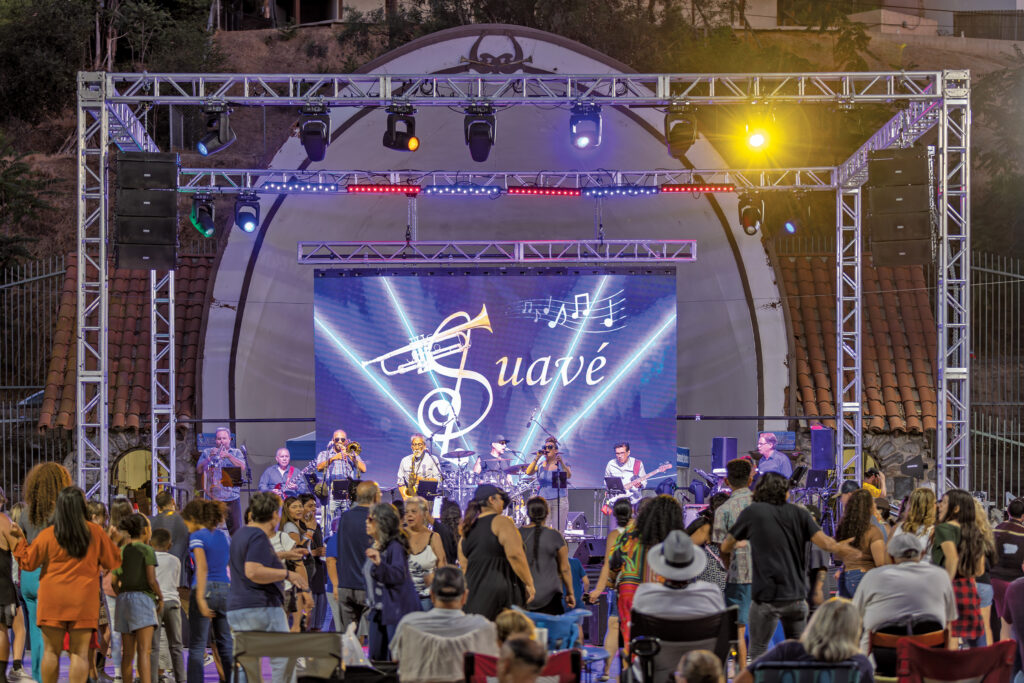
On Wednesday nights in June and July, the city’s summer concert series draws hundreds of people to the lawn in front of the bandshell. Chairs, blankets, and coolers fill the space in front of the stage.
The current structure, a 1995 rebuild after fire destroyed Arthur Benton’s original, was not designed for the kind of production the series has grown into, so a portable stage goes up each week to handle it. The crowd does not seem bothered. From salsa to soul, people dance with the friends they brought and the ones they meet when the music starts. The event is bigger than any single performance. It is a reason to get out.
The City's Bet
In January 2026, the Riverside City Council voted unanimously to lease the vacant 1959 armory building at the park’s entrance to Thompson Brewing Company under a 25-year agreement. The city will spend $2.5 million in federal funds on environmental cleanup and building renovation. A Bloomberg Philanthropies grant will pay for public art on the building’s exterior. The city has also set aside $1 million for pickleball courts on the property.
Brian and Martha Thompson have run their brewery on Indiana Avenue in the Arlington neighborhood for thirteen years. Their plan for the 12,000-square-foot armory includes a brewery and beer garden, live music, art programming, and outdoor seating at the park’s entrance. The lease runs 25 years with options to extend. It is a long commitment to a specific piece of Riverside.
The city is also exploring a bandshell refurbishment with modern sound, lighting, and a permanent stage large enough to match the series it already supports. The 1920 Benton original was a civic asset. What replaced it after the fire was a placeholder. A proper venue would complete what the concert series has already proven: that Riversiders will show up when given a reason.
Taken together, the investments at Fairmount represent a sustained commitment to the next hundred years of the park’s civic life, to the 250 acres of lawn and water between the freeway and downtown where Riversiders have always found their way back. The teenagers fishing from the shore of Lake Evans today may not be thinking that far ahead. But there is a reasonable chance they bring their grandkids to the same spot.
Article originally published in The Riversider Magazine, August/Sept 2026 issue